


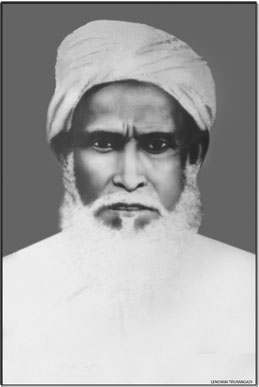
K.M. MOULAVI (1886-1964)
Founder President Tirurangadi Muslim Orphanage Committee (1943 -1964)
Date of Committee Meeting he attended last: 22-03-1964
Thayyil Mohamed Kutty Musliar, popularly known as K.M. Moulavi, an eminent Islamic scholar, religious and social reformer, freedom fighter, advocate of Hindu Muslim unity, and above all, a man of deep faith, piety and exemplary character, was the originator of the idea of a Muslim orphanage at Tirurangadi.
Born at Kakkad, near Tirurangadi, he had his higher education at the famous Darul Uloom Madrasa at Vazhakkad where he was greatly influenced by the enlightened views of his teacher and Principal, Chalilakath Kunhahamed Haji, the pioneer of the Madrasa Movement.
K.M.Moulavi was one of the earliest in Malabar to join the Khilafat Movement launched in August 1920. He actively participated in all the events and activities of the Khilafath Movement and the Indian National Congress for the freedom of the country and for the promotion of the Hindu-Muslim unity. The result was that he was charged with treason and the British government issued an arrest warrant against him. To escape the arrest, Moulavi Sahib fled Malabar to Azheekode (Kodungalloor) in Cochin State where he was given shelter and protection by the families of Sheethi Muhammed, the father of K.M. Seethi Sahib, and Manappattu Kunhi Mohammed Haji.
Here, in Cochin State, he resumed his religious and social reform work which he had already started in Malabar. It was under his leadership that the famous” Kerala Muslim Ikya Sangham”, the first Muslim socio-religious reform movement in Kerala was formed at Koduangalloor in 1922. In the second annual conference of Ikya sangham(1924) , the first scholars‟ organisation of Kerala, Kerala Jamiyyathul Ulema, was formed under his leadership. Under these two forums K.M. Moulavi worked tirelessly for the social, religious and educational uplift of the Kerala Muslims, meanwhile carrying on his crusade against the un-Islamic beliefs and practices and superstitions in the community.
After the charges against him were withdrawn by the British authorities in 1933, K.M. Moulavi returned to his native place, Tirurangadi, in Malabar, and thereafter he devoted all his efforts for the social, religious and educational development of the Muslim community. He took a leading role in establishing the Noorul Islam Madrasa in Tirurangadi, which became the nucleus for all the educational and cultural resurgence of the people in and around Tirurangadi.
In 1943, a terrible epidemic-cholera- broke out and spread in Malabar leaving many children orphans with no one to take care and no place to shelter. At this juncture K.M.Moulavi conceived the idea of an orphanage which he discussed with his associates K.M.Seethi Sahib, M.K.Haji and others. They took up the idea and implemented it without delay resulting in the inception of Tirurangadi Yatheemkhana.
Meanwhile he was carrying on his religious and social reform work. He played a leading role in the formation of Kerala Nadvathul Mujahidheen (KNM), the popular Islahee (Islamic revival) movement of Kerala. To propagate the message of religious and social reform, he wrote a number of books, a lot of articles and Fatwas and also published some journals in Arabi-Malayalam and Malayalam. While at Azhikode, he had published “Al-Irshad” an Arabi–Malayalam Monthly. The Al-Murshid Monthlywhich he had published in Arabi-Malayalam from Tirurangadi, was a beacon of genuine teachings of Islam as contained in Quran and Sunnah and the ideas of Islamic reform and resurgence. The Al-Manar Malayalam monthly, the official organ of Kerala Nadvathul Mujahideen founded under his leadership continued the tradition set by Al- Murshid.
As for his political views, K.M.Moulavi was a staunch congressman and nationalist in the beginning. Later he joined the Muslim League party and went on actively participating in it until he was elevated to the position of Vice-President of the Kerala Muslim League.
K.M.Moulavi who can rightly be called the god-father of Tirurangadi Yatheemkhana was its President from 1943 to 1964, the year of his death. The Arabic College established in the year 1971 under the Tirurangadi Muslim Orphanage Committee is named after K.M. Moulavi Sahib.
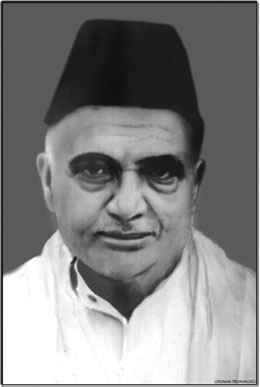
K.M. SEETHI SAHIB (1899-1961)
Founder Vice President Tirurangadi Muslim Orphanage Committee (1943 -1961)
Speaker of Kerala Legislative Assembly from February 22,1960 to April 17, 1961
K.M. Seethi Sahib, a political leader, social reformer, freedom fighter, champion of the minorities and the downtrodden, stalwart of the Muslim League Party, speaker of the Kerala Legislative Assembly, lawyer, orator and writer, was a multifaceted genius who has left his indelible marks in the political, social, educational spheres of Kerala in general, and the Muslim community in particular.
Born at Azhikode in Kodungalloor as the son of the celebrated Muslim leader of Cochin State, Haji K Sheethi Mohammed, he had his higher education at Ernakulam and Thiruvananthapuram. After obtaining B.L. Degree he was enrolled as an advocate in 1927.
Since the early years of his life he had been showing keen interest in political and social activities. He was elected as a member of the Cochin Legislative Assembly twice and continued in that position till 1933. As an MLA he could effectively voice the problems and needs of the Muslims of Cochin and got their grievances redressed by the Government.
When the Kerala Muslim Ikya Sangham, the pioneering Muslim social and religious reform movement in Kerala was formed at Kodungalloor in 1922, the young Seethe Sahib was in its forefront actively participating in all its activities. He was the editor of Ikyam monthly, the organ of the Ikya Sangham. Even after the Ikya Sangham ceased to exist in 1934, he kept on his contact with the reform efforts of such organisations as Kerala Nadvathul Mujahideen (KNM).
In 1932, K.M. Seethi Sahib shifted his legal practice from Ernakulum to Tellicherry in North Malabar, where he continued to live till 1956. During this period he rose as the most prominent Muslim leader in Malabar, while carrying on his flourishing legal practice.
It was with Seethi Sahib, along with M.K.Haji Sahib, that K.M. Moulavi discussed the idea of starting a Muslim orphanage at Tirurangadi. Seethi Sahib rendered all possible guidance and help to see the dream come true and continued his patronage at all stages of the development of the orphanage.,
An ardent nationalist as he was, Seethi Sahib associated himself with all the activities of the Freedom Movement under the leadership of the Indian National Congress. He was a member of the Congress Working Committee of Kerala and a member of All India Congress Committee. He was one of the earliest leaders of Congress Party in Cochin State. He had attended the Lahore Conference of the Congress Party in 1929.
In 1933, he resigned from Congress and joined the Muslim League. From 1934 onwards he had been working hard to strengthen the Muslim League until he became a prominent national leader of that party. He was elected as a member of the All India Muslim League Council in 1934, and a member of its working committee in 1948. He had served as the General Secretary of the Kerala State Muslim League for several years and as the General Secretary of All India Muslim League.
Seethi Sahib was elected as a member of the Madras Legislative Assembly from Malappuram constituency in 1946 and 1951. He could make his and his party‟s presence felt in the assembly as an effective parliamentarian and served successfully as Panel Chairman and as a member of various committees, whenever he was elected in those positions. Once he saved the Madras Government from falling due to a crisis, by extending his party‟s support to the ruling party.
In the 1960 election to the Kerala Assembly he was elected from Kuttippuram constituency. This time he was elected as the Speaker of the Kerala Legislative Assembly, which he held with commendable competence and to the satisfaction of all sections.
A forceful speaker with great oratorical skill, he was a good translator also. It was he who translated the speeches of Mahatma Gandhi when he visited Kerala. The quality of the translation won him accolade from one and all including the Mahatma himself.
Seethi Sahib was a writer with good linguistic and literary flourish. He published many articles in various papers, periodicals and journals and has authored two books “Mohammed Ali Jinnah” and “Moulana Mohammed Ali”.
Seethi Sabib had rendered yeoman service to the educational progress and uplift of the Kerala Muslims, giving birth to many educational and charitable institutions and movements including Farook College at Feroke and the Tirurangadi Yatheem Khana and its attached institutions.
K.M. Seethi Sahib served as the first Vice-president of the Tirurangadi Muslim Orphanage Committee from 1943 to 1961, the year of his demise. The Teachers‟ Training Institute under the Tirurangadi Muslim Orphanage Committee, Tirurangadi is named after Seethi Sahib.
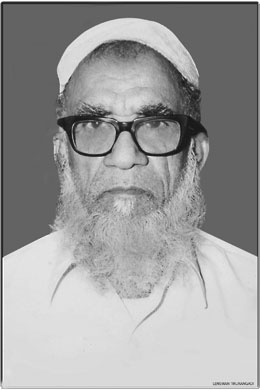
M.K. HAJEE SAHIB
Founder General Secretary of Tirurangadi Muslim Orphanage Committee (1943 -1983)
Chairman P.S.M.O College Managing Committee(1968-1983)
M.K.Haji was born in 1904 in a poor family at Palathingal about 5 KMs away from Tirurangadi. His parents were Janab Moonnukandan Ahmed kutty and Vattaparamban Beevi. At the age of 2 ½ years, his father died. When he was 3, along with his mother, he began to settle in Tirurangadi. Till the age of 14, he had been selling in the market the flat rice cakes (Kaipathiri) prepared by his mother for their livelihood. He learned Quran reading from a recitation centre (Othupalli) and got primary education upto standard 4 from a primary school in Tirurangadi. When young, he had a healthy physique and was a strong head load worker and a trolley puller.
His name Moonnukandan Kunnhahmed later became famous as M.K. Hajee.
In 1918, when he was 14 years old, he left home and joined the Malankara Estate as a labourer and later became its supervisor. In 1920, he returned to Tirurangadi. It was a time when the Khilafath Movement, the Malabar Revolt and the Independence struggles were strongly progressing. Kunnahamed was attracted by them and began to work as a volunteer of the Khilafath at the age of 16. Being a follower of Mohammed Abdurahiman Sahib, he was a Congress Party man at that time. Some antagonist betrayed him by reporting to the police authorities that he was a rebel. To avoid arrest, he fled to Madras with an empty pocket. There he laboured much, worked as a hawker and got himself engaged in hotel works. After hard sufferings of 40 years, he became the owner of 5 hotels in Madras and bakeries in Madras, Bangalore and Bellari and an estate in Edakkara. Gradually he rose from rags to richness.
In the beginning, Kunnahamed was involved in many religious blind beliefs and he actively participated in Mauleed and Ratheeb functions. It was only by the contact with Janab K.M. Moulavi sahib that he became free from all such superstitions and began to work and propagate as a strong believer of Islahi Movement.
In the year 1937, by the influence of K.M .Moulavi sahib, he took membership in the Indian Union Muslim League and later gave powerful leadership in the growth and development of the League in Kerala. He was the treasurer of the Malabar District Muslim League and then Treasurer of the State Muslim League when Kerala State got its birth. He took pivotal role in structuring and developing the Tamil Nadu Muslim League also. Because of the unfortunate split in the Muslim League in 1975, he was posted as the President of the newly born All India Muslim League. He was the director of the Chandrika news paper and the chairman of the Managing Committee of the „League Times‟, the newspaper run for the All India Muslim League.
Consequent on the terrible outbreak of Cholera epidemic in the South Malabar in 1943, hundreds of children were orphaned with no one to take care of them. On receipt of a letter from Janab K.M.Seethi Sahib and Sathar Sait Sahib in Thalasseri, M.K. Hajee started visiting with some friends all the Cholera struck houses in Tirurangadi and neighbouring regions and did much relief works. Along with K.M.Moulavi and K.M. Seethi Sahib, he took important role in the establishment of the Tirurangadi Yatheemkhana. Since the date of formation of the Tirurangadi Muslim Orphanage Committee in 1945 for running the Yatheemkhana, M.K.Hajee had been the General Secretary of the Committee till his death.
All the institutions like the Orphanage U.P. School, the Oriental Higher Secondary School, the Seethi Sahib Memorial Orphanage Teacher Training Institute, the K.M. Moulavi Memorial Orphanage Arabic College, the Pocker Sahib Memorial Orphanage College, and the Darussalam Masjid were established by the committee under his leadership and guidance. He was also one among the main leaders of starting the Noorul Islam Madrasa in the year 1939. M.K.Hajee had an earnest desire to construct a hospital also under the committee. Though he had prepared a plan and estimate, he could not start constructing the hospital till death. But his successor, C.H. Kunnahmed Hajee materialised his dream by establishing the M.K.Hajee Orphanage Hospital in the year 1996.The hospital preserves the lasting memories of the departed leader by serving the community in a quasi charitable manner.
M.K.Hajee‟s service in the educational, social and cultural fields cannot be confined in Tiruranagadi alone. He played a pivotal role in the starting and development of the Mampad College. He was a member of the Farook College and Rouzathul Uloom Arabic College committee, the Edavanna Jamiya Nadviyya committee and the Kerala Muslim Educational Association. He was the State Vice President of the Kerala Nadvathul Mujahideen and the Vice President of the Valavannur Ansar Arabic College Committee. He had also taken a leading role in the formation of the Malabar Muslim Association in Madras.
Having enriched the history of Tirurangadi by his noble deeds in life as a father of orphans and philanthropist, as a promoter of education, as a religious and social reformer and as an ideal political leader, M.K. Hajee left this world on 5th November 1983.
C.H. KUNHAHMAD HAJEE
Khasi of Chaliyam had deputed one Sayed Moosa to Tirurangadi for preaching Islam. This Sayed Moosa‟s grandson is Khusayyu Hajee (Kuthayi Hajee). Those who embraced Islam and studied about it by the efforts of this Khusayyu Hajee came to be called as “Shaliyathikal” (Chalilakathukar). There were many religious scholars among the descendents of Khusayyu Hajee. C.H. Kunhahmad Hajee is the son of one of the many descendents in that family. His father C.H. Mohamed Master was the owner of a printing press in Tirurangadi.
Kunhahmad Hajee, popularly known as Kunhadu Hajee, was born on 15th August 1931. He did his Matriculation education from the Mappila High School, Malappuram during the years 1944-47. His Intermediate Course and B.Com degree course were done from the Islamiya College, Vaniyambadi in Madras (Tamil Nadu). After getting his B.Com degree in 1953, he got appointment in the Revenue Department of the Madras government. But as his father was not in favour of his continuing in the govt. job and as he had enough self employment possibilities in their printing press etc., Kunhahmad Hajee resigned from the job after 6 months service in the Dept.
Kunhahmad Hajee got membership in the Muslim Orphanage Committee in the year 1957and he was elected as the Assistant Secretary of the Committee in 1961. From the beginning of his joining the Committee, Kunhahmad Hajee had been rendering devoted service by giving sincere help and support to M.K. Hajee, the General Secretary in the administration and well being of all the institutions under the Committee. M.K.Hajee trusted him much and did nothing without hearing his authentic opinion and advice. Consequent on the sad demise of M.K.Hajee in 1983, Kunhahmad Hajee was unanimously elected as the General Secretary of the Committee.
M.K.Hajee‟s last ambition was to establish, among other institutions, a hospital also in the campus. But he could not do it. Kunhahmad Hajee, his successor, materialised this great ambition by establishing the M.K.Hajee Orphanage Hospital in the campus in 1996. The hospital is regarded as one among the most important milestones in the path of history of Kunhahmad Hajee‟s reign as the Gen. Secretary of the Committee. He left this world on 8th August 2012.
Kunhahamad Hajee was very particular in observing all the values and dreams cherished by the founders K.M. Moulavi Sahib, M.K.Hajee Sahib, Seethi Sahib etc. He successfully drove to the forefront all the institutions under the Committee in a noble and ideal manner.
Kunhahmad Hajee was always friendly, democratic and just with higher vision in his social interactions and was also very strict in following all the concerned laws and rules in the official matters.
Because of his physical disability and exhaustion during his tenure, Kunhahamad Hajee expressed his in ability to continue as the General Secretary and thus Janab M.K. Bava was elected instead. A few months later, Kunhahamad Hajee passed away on 8th August 2012.